Monday, April 23, 2007

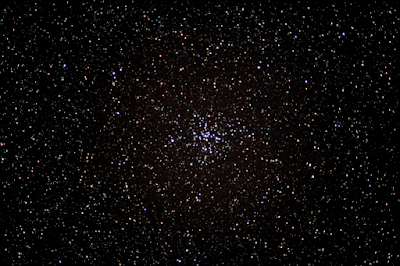
re: Messier 44, aka, The Beehive


M-44 is the final image from the night of April 19. It's hard to believe that Messier could have mistaken M-44 for a comet, since it's a huge (nearly 1.5 degrees in diameter) naked-eye object (3.7 visual magnitude) better suited to binocular than telescopic viewing. (Click on the image for a larger view.)
I previously noted that the Borg field of view is nearly 4 degrees across the long dimension. Thus the enormous size of M-44 is readily apparent. Professional astronomers believe that both the Hyades and the Beehive originated in an enormous nebular cloud, much like M-42, some 750 million years ago. M-44 is nearly 670 LY distant from the solar system.

Clear skies.
Max

Image Acquisition and Processing Data
Camera control with ImagesPlus 2.82 using the Xti and Borg f/4 astrograph on the CG5 mount
Autoguiding with C102, PHD and Meade DSI
5 subs at 1 min/ISO1600(5 total minutes)
Eight darks at 1 min/ISO 1600
No bias or flats
Converted, calibrated, aligned, stacked, digitally developed in IP
Resized in PS CS2
Astronomy Tools star reduction action and increase star color action
Converted for the web in PS CS2

Saturday, April 21, 2007

re: The Leo Trio (more results from April 19)


The Leo Trio is an often imaged object, and thus offers abundant opportunity for comparisons with the work of others. I'd like a tighter shot to show more detail in the galaxies, but that goal will have to wait for "new equipment." (Click on the photo for a larger image.)
The Trio (in the middle of the image) is comprised of NGC3628 at the upper right, M65 on the bottom right, and M66 on the left. One additional galaxy is visible at the bottom of the image near the middle. With additional "new equipment" (like a dedicated astroimaging camera) and longer exposures additional galaxies would be visible -- there are literally dozens in the FOV.
The subs were acquired before those of Markarian's Chain. I was still "tweaking" the autoguiding, so there is some trailing visible. But given that the majority of the subs were 3 minute exposures, I'm not disappointed. Live and learn, eh? Likely I need to reprocess the subs, and eliminate a few frames, but that will have to wait another day of processing.
Clear skies.
Max


Image Acquisition and Processing Data
Camera control with ImagesPlus 2.82 using the Xti and Borg f/4 astrograph on the CG5 mount
Autoguiding with C102, PHD and Meade DSI
14 subs at 1 min/ISO1600
15 subs at 3 min/ISO1600
(59 total minutes)
Eight darks at 1 min/ISO 1600
No bias or flats
Converted, calibrated, aligned, stacked, digitally developed (settings 0, 1.04, 4500, soft sharpen), auto stretch, saturation-brightness adjustment 1.2 in IP
Resized in PS CS2
Astronomy Tools star reduction action, increase star color action
Small levels and curves adjustment in PS CS2
Rotate 180d
Converted for the web in PS CS2

re: Markarian's Chain and Autoguiding


Will miracles never cease? After a long run of cloudy and blustery nights, including a 9" snow and several rainshowers, April 19 offered a calm and clear night.
Several "advances" (relatively speaking) were made. For one, I was finally able to field test the autoguiding setup (PHD Guiding + Meade DSI). With a minimal amount of tweaking the CG5 mount was tracking like never before! My compliments to Craig Stark, who distributes PHD Guiding as freeware. (Click on the photo for a larger image.)
The second step ahead was tweaking the focus using ImagesPlus rather than my own eye. Eric Jacob and Mike Reid had noted that the focus was soft in the previous images. And finally I increased the exposure from 60 seconds to 180 seconds. (Acquisition and processing details below.)
The photo has a good bit but not all of Markarian's chain included. The two bright galaxies near the middle of the photo are M84 (on the right) and M86. M87 is in the lower left. Altogether I can count 22 galaxies in the image -- all part of the Virgo Supercluster. If the opportunity presents itself I plan on capturing the missing Messier objects (M88-M91, M99, and M58) and then taking a shot at my first mosaic image.
Abundant information on Markarian's chain can be found online. Here's a link to a fabulous astroimage by Karel Teuwen of Markarian's Chain.
Clear skies.
Max
Image Acquisition and Processing Data
Camera control with ImagesPlus 2.82 using the Xti and Borg f/4 astrograph on the CG5 mount
Autoguiding with C102, PHD and Meade DSI
18 subs at 3 min/ISO1600
(54 total minutes)
Eight darks at 1 min/ISO 1600
No bias or flats
Converted, calibrated, aligned, stacked, digitally developed (settings 0, 1.05, 4500, soft sharpen) in IP
Resized in PS CS2
Astronomy Tools star reduction action, enhance deep sky object action, and increase star color action
Converted for the web in PS CS2

Friday, March 23, 2007

re: M-81, M-82, Coddington Complex


The M-81, M-82, Coddington complex is part of the Local Group of galaxies, which includes M-31 and our own Milky Way Galaxy. As Galaxies go, they’re practically next door at a mere 12 MLY.

I enjoy the widefield image, but two points stand out. Visual observation of M-81 and M-82 through the C-14 and a 12mm TeleVue eyepiece provides details that cannot be seen in the image. (See the technical specifications below: at 4.28 arc secs per pixel you lose fine detail.) And I’ve viewed some prime focus amateur photographs of these galaxies that absolutely knocked my socks off – most recently at: http://infiniti-eng.com/astrophotos/displayimage.php?pos=-53

As previously noted, "prime focus" imaging is on my list of things to do! But I’ve a lot more dues to pay.
Cheers.
Max

Addenda

M-81, also called Bode’s Nebula
Magnitude: 7.0
Size: 24.9 x 11.5

M-82, also called the Cigar Nebula, also called the Exploding Galaxy
Magnitude: 8.6
Size: 11.2 x 4.3
http://www.seds.org/messier/m/m082.html

Coddington’s Nebula (NGC 3077)

Data acquisition and processing details
Camera control with ImagesPlus 2.82 using the Xti and Borg f/4 astrograph
16 subs at 1 min/ISO1600, unguided on March 16
8 darks at 1 min/ISO 1600
No bias or flats
Converted, calibrated, aligned, stacked and stretched in ImagesPlus 2.82
Resized and cropped in PS CS2
Astronomy Tools reduce star size, enhance DSO contrast, reduce space noise, diffraction spikes on medium stars
Adjust levels, curves, hue and saturation in PS CS2
Converted for the web in PS CS2

Equipment for widefield DSLR
Borg 77mmED f/4 (using super reducer)
Canon Xti (unmodified)
Hap Griffin astrocable
CG5-Go To GEM
Telrad
Dual saddle by Ken’s Rings
Celestron 102 guide scope
Meade DSI camera for guiding

Technical specifications for widefield DSLR
Borg/Xti Field of View: 167'x251' Field of View (2.78E x 4.18E)
2394x3520 pixel array
4.28 arc seconds/pixel

Incidental notes
Dell Inspiron camera control
Dell Dimension Intel duocore processing

Thursday, March 22, 2007

re: M-41 and more on dim bulbs

I've added a second image featuring M-41. As with the M-35 image, what really intrigues me in the image are the dim bulbs.

Having lived in Flagstaff for nearly a decade, I got to know several of the local professional astronomers . While Lowell’s new "Discovery telescope" will be dedicated to the search for NEO’s, a significant part of the USNO’s research program involves measuring the parallax of the "dim bulbs" – otherwise known as red dwarfs. It's a treat to view some through the 155m (61") astrometric reflector. Link: http://www.nofs.navy.mil/

The bright stars and the Milky Way itself tend to mesmerize the lovers of the night sky. Of course! The visual threshold, as all amateurs known, is mag 6.0 (and for people with really sharp "peepers" slightly beyond that). From a dark site on a moonless night, then, about 3000 stars can be viewed without optical aid on any one evening. As it turns out, however, those stars are just the tip of the galactic iceberg. The dim bulbs constitute the overwhelming majority of stars, perhaps as high of 90 percent of the total number.

One of my favorite astronomical writers is Chet Raymo. "For every yellow star like our sun in the middle of the main sequence," he writes, "there may be ten times as many red dwarfs" (p. 66, 365 Starry Nights).

Raymo’s on solid ground. James Kater’s excellent The Hundred Greatest Stars (a must have, in my opinion) writes that "by the far the most numerous kinds of stars are the faint M, L, and T dwarfs, which constitute at least 80 percent of the whole tally. As one climbs the main sequence, the numbers quickly drop; fewer than one star in a million is class O" (p. xx, Kater).

The Rigel’s, in other words, are the stellar freaks! It’s the dim bulbs that are the average Joe’s. All of these stars are, of course, invisible to the naked eye. In fact, most of them are beyond the reach of smaller aperture amateur telescopes. Which is why, when I first "stretched" the image of M35/NGC2158 and saw all those dim bulbs the experience was an immediate "Shazam, Holy cow, unreal, dude!" astronomical surprise.

Color me a rookie, eh? ;-) I was preoccupied with the techniques of astroimaging and conceptually disengaged – i.e., smacked with a stupid stick. The contemporary era of charge-coupled-collecting devices, computers and such has revolutionized stellar study, including the study of the dim bulbs. And the results have tended to upset the accepted picture of star formation and distribution. The accepted hypothesis has been that stars were born in stellar nurseries like the M42 complex, formed clusters like M35, and eventually wandered off as "single stars" – for example, Sol.

To make a long story short: "[I]n the last 15 years or so, astronomers have used more sensitive telescopes to survey smaller, dimmer stars called red dwarfs, which are between 10% and 50% the mass of the Sun. ‘The faint stars are harder to see, but they make up 85% of all stars in the galaxy, and three quarters of those are single,’ [according to astrophysicist Charles] Lada.... ‘I think the result strongly favors the idea that most stars form initially as single objects, not in multiple systems.’ "
"That goes against current models, which explain the existence of single stars by arguing they are born with siblings and are then separated after a gravitational interaction with another star. ‘You can certainly form a lot of stars that way, but with so many single red dwarfs, there's no simple way’ to explain them all, says Lada."
Source: http://space.newscientist.com/article/dn8640.html

Let me direct your attention back to the image of M35 from yesterday.Whoa, Nelly, that’s a whole lot of single stars, eh! And wow, are they dim. Makes me wonder just how low can we go in that image? Meaning, how faint are those dim bulbs? The starfield through my C14, which has a limiting magnitude around 15.3 (according to the manual: in use maybe mag 12 or so), is nowhere as rich as the image.

Let me use one of my planetarium programs to grope for answer. In my normal settings for The Sky no stars dimmer than mag 14 appear. With that setting the star field is clearly not as rich as the star field in the image. Left-clicking on the smallest stars gives data such as:
Object name: GSC 1868:2661
Magnitude: 13.7
Object name: GSC 1868:1857
Magnitude: 13.4

If I tweak "The Sky" (>"View"> "Stellar Options">"more stars" (move the slider for "more stars" all the way to the left) I can repopulate the "stellar field" with some really faint stars like these:
Object name: GSC 1881:232
Magnitude: 14.6
Object name: GSC 1881:744
Magnitude: 15.6

GSC1881:774 is the faintest star I can find. There may be some fainter ones. And by adding additional catalogues I might be able to tweak The Sky stellar field in the vicinity of M35 to approximate that of the image. But as a close comparison of the image and The Sky’s stellar field makes clear, there’s a bunch of dim bulbs in the image not on The Sky. For example, study the field at about 7 o’clock very near to M35.

Thus, a provisional answer to the question of "how low can you go with 5 minutes worth of subs?" Pretty low. Mag 16? Mag 17? I’m not sure.

In any case: Sagan was right. Billions and billions of stars. Most of them dim bulbs.
Cheers.
Max

More technical details concerning red dwarfs can be found online.
1. A short defintion and discussion at:
http://www.astro.umd.edu/educationalresources/astro/stev/rdwarf.html
2. Red dwarfs within 10 parsecs of Sol (a must see):
http://www.solstation.com/stars/pc10rds.htm
3. Short discussion with links:
http://jumk.de/astronomie/about-stars/red-dwarfs.shtml

Wednesday, March 21, 2007

re: Caveat emptor: wonky details below


Unless you enjoy astroimaging, there's not a snowball's chance in Hell that you'll find anything of interest in this post. And even if you are an "insider," you may be bored beyond belief.
The photograph shows my basic setup in the "driveway observatory" and the longer-term "vision." I'm starting in the "easy mode," meaning widefield DSLR astroimaging. And in the next year I want to add prime focus imaging at f/6.3 through the Celestron 14" using a dedicated astroimaging camera. (Click for large view.)
The widefield set-up is as follows: CG5-Go To mount, which has been a pleasant surprise in both go to accuracy and tracking, given its relatively low cost. Borg 77mm astrograph at f/4 with the Borg super reducer: no surprise here. An excellent instrument free of chromatic aberrations with flat-fields edge to edge. Celestron 102 guide scope: again, a pleasant surprise given the very low cost of this instrument. Meade DSI camera for guiding only. (I would not recommend this device for imaging.) Canon Xti DSLR for imaging.
The Borg/Xti combination yields a 167'x251' Field of View with a 2394x3520 pixel array at 4.28 arc seconds/pixel. The M-35 image posted immediately prior to this post shows both the "costs and benefits" of such a setup. Very wide FOV (2.78dx4.18d) showing a few hundred of the dim bulbs that make up Sagan's "billions and billions of stars." But at 4.28 arc seconds per pixel the exquisite nature of "cosmic jewel boxes" like NGC-2158 is simply not apparent, becoming little more than a smudge. M-35, on the other hand, is nicely resolved.
The data acquisition and processing details are:
Camera control with ImagesPlus 2.82 using the Xti and Borg f/4 astrograph
Five subs at 1 min/ISO1600, unguided on March 16
Eight darks at 1 min/ISO 1600
No bias or flats
Converted, calibrated, aligned, stacked and stretched in ImagesPlus 2.82
Resized in PS CS2
Astronomy Tools star color action
Converted for the web in PS CS2
Incidental notes: "in the field" PC control via a Dell Inspiron. All processing done on a Dell Dimension 2 gig memory Intel duocore. I highly recommend Mike Unseld's ImagesPlus and Noel Carboni's Astronomy Tools.
There are multiple examples online of expert-level widefield DSLR astroimaging. I'll leave you to your own devices in that regard. Special thanks to Eric Jacob who's been a constant conversational partner and source of advice and encouragement.
There are only a few who are achieving expert-level imaging with the C-14. The most inspiring and generous with his advice is Lyndon Thompson. http://www.lyndonthompson.co.uk/
Cheers.
Max

re: M-35/NGC-2158 astroimage


In the last month I've been "gearing up" (almost literally) for having a go at astroimaging. As the British like to say, "There's many a slip between cup and lip." So I've learned.
I'm about ten percent down the road towards the destination: actually winding up with some astroimages of decent quality. The image here is M-35. Click on the image for a full screen view.
To me the most interesting features of this image are (a) the star colors, (b) the "3-D illusion" of the M-35 cluster, and (c) the myriad "dim bulbs" - meaning faint stars that cannot be seen with the naked eye. The hundreds of them that appear on the image remind me of Carl Sagan's "billions and billions and billions of stars!" Indeed. And most of those billions and billions of stars in the Milky Way are dim bulbs. We're very lucky, by the way, that Old Sol is not one of them.
I won't reveal my limited astrophysical knowledge by discussing the importance of star colors. Simply think of a star's color as indicating its temperature. For example, red stars are relatively cool, aging stars like Betelgeuse and Aldebaran. Blue-white stars are often younger, intensely hot, super-giants like Rigel (estimated 55,000x more luminous than Sol, 910LY distant from us). Sirius outshines Rigel, but only because it is so close to us, at 8.65 LY, the fifth closest star (approximately 22x more luminous than Sol).
The flaws in the image of M-35/NGC-2158 are many, not the least of which is a modest amount of star trailing (that is readily apparent at the pixel level). Autoguiding during image acquisition is the obvious solution, but that "next step" has provided several complications to date.
The wonky details "behind" this photo are boring to anyone except fellow astroimagers, so I'll place them in subsequent posts.
Cheers.
Max